How many restrooms does a marathon need?
Runner count and course layout drive the number, not one flat formula. A field of a few hundred spread across a 5K start line needs far less than a marathon with staggered waves and a long finish chute. We look at your race restroom plan the way OSHA 1926.51(c) frames worker sanitation ratios: one fixture per cluster of people, sized to the group, not the event as a whole. For public races, that means separate clusters at the start corral, at least one mid-course stop, and a bank near the finish where the crowd lingers longest. Standard units run 100 to 350 dollars a day depending on quantity and placement, and a multi-point race weekend often makes more sense as a flat weekend rate, which lands between 125 and 400 dollars per unit. Add ADA accessible units to every cluster, not just the main one. ADA Standards section 213.2 requires at least 5 percent of clustered single-user toilets be accessible, with a minimum of one, so a race with restrooms at four checkpoints needs an accessible unit at each, not just downtown near the finish stage. If your course runs through Federal Way and finishes near a park pavilion, we can also route handwashing stations alongside the toilets so runners aren't just wiping hands on a bib.
How to brace a temporary power pole at a race timing tent?
Timing tents, PA systems and finish line clocks usually run off a temporary power pole rather than a generator, and bracing it right matters more on race day than most people think, because thousands of feet and a few stray dogs can catch a guy wire. The pole needs a stable base plate set on level ground, guy wires anchored well outside the runner lane, and the wire runs kept clear of the accessible route entirely. ADA Standards section 403.5.1 sets a 36 inch minimum clear width for an accessible route, so any power run crossing a course path has to either bury the cable, ramp it, or reroute around that 36 inch corridor. Ramped cable crossings should not exceed the 1:12 slope limit under ADA Standards section 405.2, which matters if your timing tent sits at the finish line where wheelchair racers or handcycle divisions cross. We coordinate pole placement with your temporary fence rental layout so the barrier line and the guy wires don't fight each other, and we keep the pole footprint out of the runner chute entirely. If your race also needs crowd control barrier at the finish, plan that layout at the same time as the power pole, since both compete for the same strip of sidewalk.
What does race restroom placement look like on a real course?
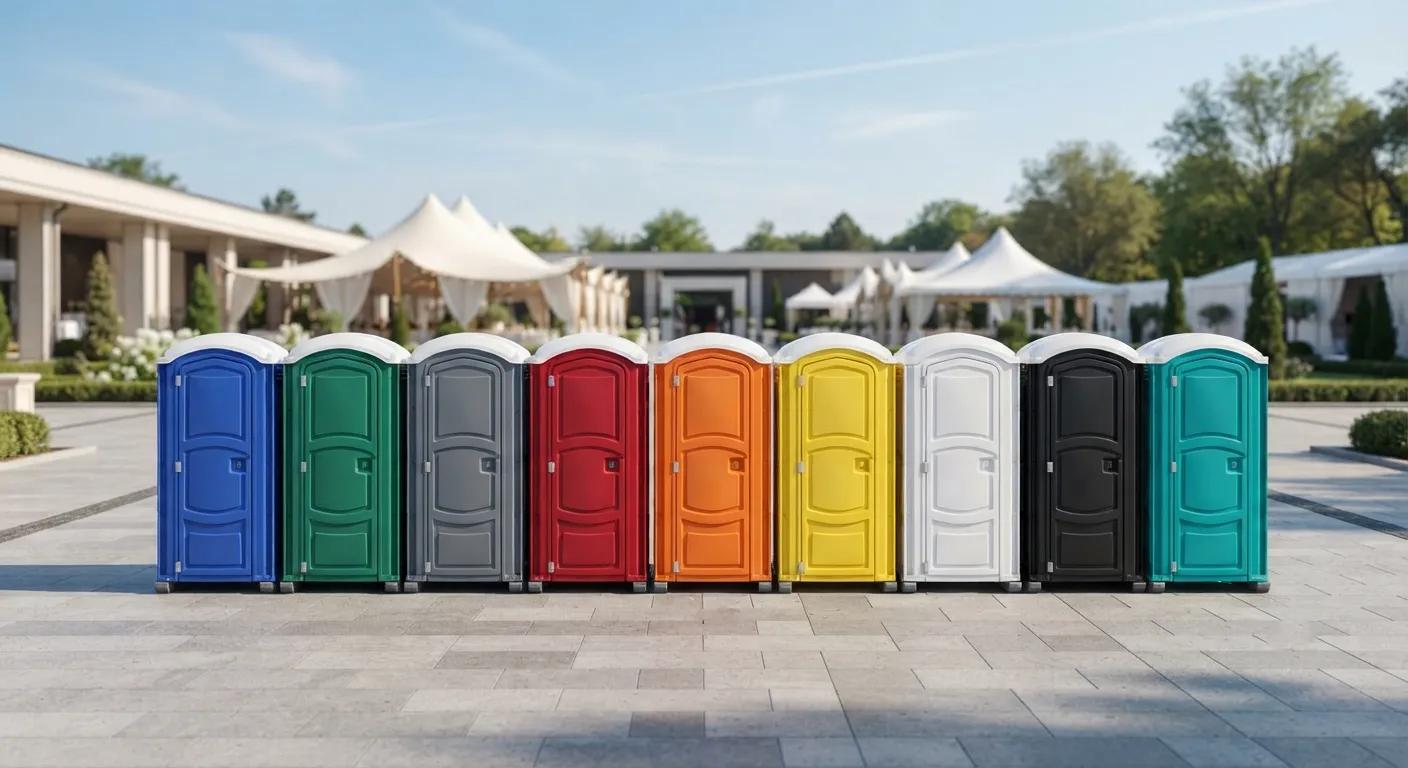
Placement follows the runners, not the parking lot. A typical Federal Way race spreads units at the start line, one aid station near the midpoint, and a bank of six to ten units at the finish, scaled to expected finishers in the first hour. Ground clearance matters too: a standard unit runs about 44 by 48 inches on the ground and stands roughly 92 inches tall, so tight sidewalk pinch points near downtown storefronts need to be checked before delivery day. If your event needs a nicer option at a VIP or sponsor area, a deluxe flushable porta potty or a compact restroom trailer rental works well near a finish line stage, and a 2 stall restroom trailer handles sponsor tents without the wait of a single unit. Larger fields sometimes route a full 4 stall restroom trailer to the finish area instead of stacking single units. For courses that dip into nearby towns, our trucks already run 6.6 miles south to Milton and 7.0 miles north to Des Moines for other events, so extending a marathon route across a city line rarely adds real cost. Whatever the layout, we service every stop the morning of the race and pull all units once the course reopens to traffic, keeping temporary fencing and barrier gear in place until the last sweep vehicle passes.
How far in advance should I book race restrooms?
Book as soon as your course map and expected field size are set, ideally weeks out for anything over a few hundred runners. Race weekends compete with construction jobs and other event restroom bookings for the same trucks, so early placement locks in count and location before the calendar fills.
Do I need ADA units at every checkpoint or just the finish?
Every cluster needs at least one accessible unit under ADA Standards section 213.2, not only the finish line. A start corral, a mid-course aid station and the finish area each count as a separate cluster, so each needs its own ADA accessible porta potty.
Can restrooms be serviced mid-race if the event runs long?
Yes, for long-running events like ultras or all-day festivals we can schedule a mid-event service pass. Most single-day races just need one setup and one pickup, but a course that stays open past normal service hours can get an added stop.
What is the difference between renting for a race versus a construction site?
Race rentals are short bursts tied to weekend or single-day rates, while construction site services run for weeks or months under OSHA 1926.51(c) worker ratios. A race weekend for standard units runs 125 to 400 dollars per unit, well below a month-long job site rate.
Do you deliver to towns near Federal Way for regional race courses?
Yes, we already reach nearby communities including Edgewood at 7.7 miles southeast and Fife at 8.2 miles south. A regional course crossing city lines is normal for us and doesn't change how we plan the porta potty rental layout.
Next step
Get a delivery date
Tell us the address, the dates and the headcount. We size the order and confirm the route.